
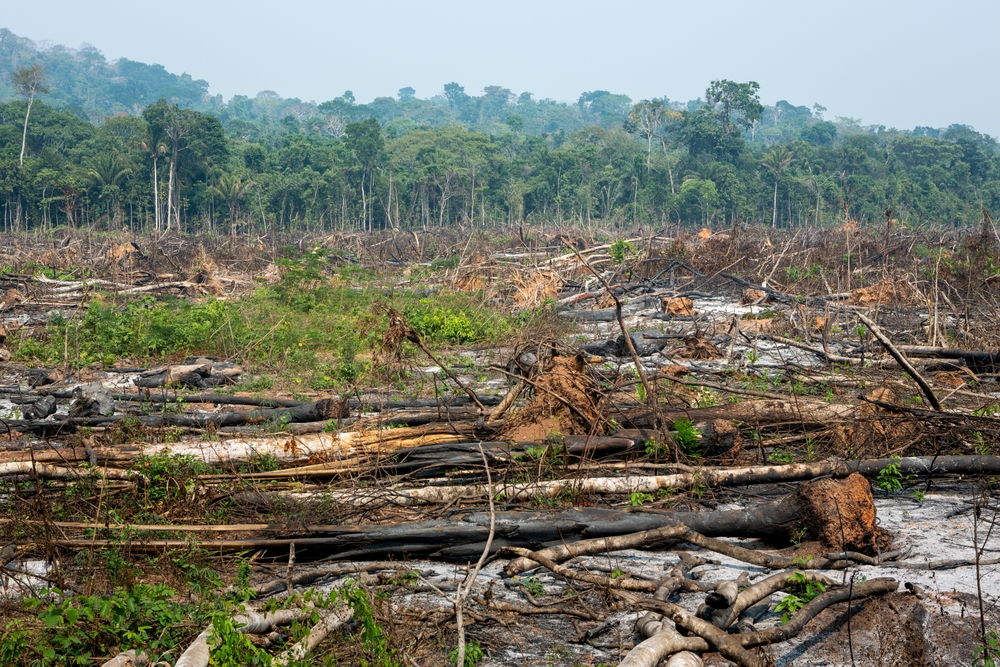
Forests around the world are vital for maintaining a healthy planet, and we face increasing threats from deforestation. The European Union (EU) has taken a strong stance against deforestation linked to certain commodities, aiming to ensure consumption doesn’t contribute to environmental degradation. This has significant implications for publishing, particularly regarding the paper used in printed journals.
Here’s what publishers need to know to ensure their journals can be distributed in the EU on and after December 30, 2024.
Understanding EUDR
The EU Deforestation Regulation (EUDR) aims to ensure products entering or leaving the EU market aren’t linked to deforestation or forest degradation of specific commodities, like the timber used to produce paper. This law, announced in the spring of 2023, is part of the comprehensive EU Green Deal and is slated to go into effect on December 30 of this year.
The EUDR is requiring EU importers and exporters of the commodities covered under the law to provide verifiable proof that their products are harvested from forests that have been deforestation- and forest degradation-free since 2020. A mandatory Due Diligence Statement, created by the EU, and extensive supplemental data are required with every shipment. Of particular note, the Due Diligence Statement must include the specific geolocation of ALL plots of land where the product (trees, in this case) was harvested, along with time and date range of production. The law states that noncompliance can result in fines and products could be seized.
Why does this matter to publishers?
The EUDR regulates materials used to make paper — everything from printer paper and packaging materials to paper towels, personal products, and books. Yes, journals fall into this category. Many publishers serve a global audience, distributing their journals not only in North America but also in Europe, the UK, and Asia. Understandably, they have questions — namely, “Will the paper my publication is printed on be compliant with this ruling?”
For those in the forest-to-pulp-to-paper-to-printed-product supply chain, answering that question starts with understanding the law completely and diligently following developments leading up to the deadline. To say that there is some confusion — and concern over what many certifying agencies and other stakeholders have expressed as a lack of specificity on the “how to” component of the regulation — would be an understatement. At the crux of the issue, globally, is how paper is manufactured today.
The following infographic, created by the American Forest & Paper Association (AF&PA) lays it out:
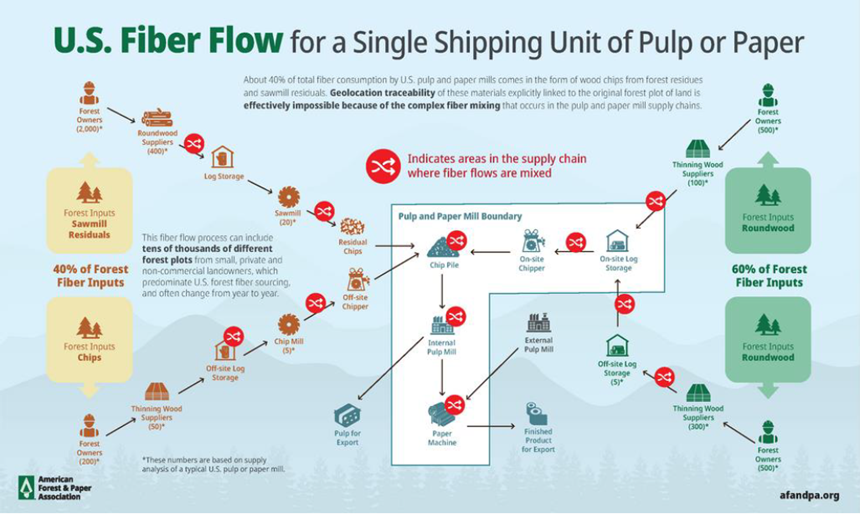
The paper supply chain is complex, with wood traveling through multiple stages — from forest to pulp mill, to paper mill, to certifying agency, and even to further paper refinement entities — before ever reaching the printer. One bale of pulp may be connected to thousands of plots of forest land. Determining specific geolocations of harvesting forests once the pulp enters the production process would prove an all-but-impossible task — not just for the U.S., but for pulp and paper mills around the world. Will this roadblock disrupt trade between the EU and the U.S. or, for that matter, between the EU and the rest of the world?
In the U.S., there are a number of well-established certification organizations, and each has been working to come to terms with this ruling since its inception. There is a common theme in their perspectives and responses that may be unique to the U.S. — and that is, while these entities fully support the goal of EUDR, the U.S. has a “long history of sustainable forest management” and a proven track record of success in environmental stewardship. Bottom line: The U.S. paper industry is NOT linked to global deforestation and forest degradation.
What’s happening, what’s next
Most of the U.S. certification organizations, as well as some in the EU, have approached the European Union with suggestions and solutions. The AF&PA has provided data to the EU, showing that U.S. forests not only are stable but are growing significantly. They point to their sustainability goal to advance Better Practices by 2030. Acknowledging that AF&PA supplies about 60% of specialty pulp that EU manufacturers use to make personal products alone — and that the U.S. supplies 85% of that specialty pulp globally — their appeal is that the European Commission consider the challenges EUDR imposes and revisit the ruling, especially in light of the U.S.’s well-established, strong, and sustainable forest management. The appeal also suggests the U.S. be viewed as a “low risk” country.
And the AF&PA is not alone. U.S. Senators, members of the U.S. House, and even members of the EU are calling for reconsideration and/or a delay in implementing the law.
As the year rolls on, stakeholders continue to remain vigilant and engaged. Certifying parties such as the Forest Stewardship Council (FSC) and Programme for the Endorsement of Forest Certification (PEFC) — while already very well positioned to meet most key EUDR elements, have been working intensively to align their practices as closely as possible with EUDR requirements. Detailed FAQs and tool kits outline their progress.
Collaboration, transparency, and acknowledgement
Collaboration among all members of the forest-to-paper supply chain is essential for navigating the EUDR effectively, as are active engagement and open communication with the EUDR regulatory body. It has become clear that more detail and guidance are needed from the EUDR, as well as — in the case of U.S. suppliers — an acknowledgment from the EUDR that the U.S. pulp and paper industry is not linked to global deforestation and forest degradation.
Stay informed about EUDR
Understanding the EUDR and any new developments that may impact the ruling is a simple matter of asking your printer where things stand. Much has been done on this front, and much weighs on the European Union’s ability to provide more specificity and consider revising or adjusting the rules, particularly for countries that do not contribute to deforestation.
Contact your Sheridan or KGL representative for a consultation or visit our contact pages (Sheridan contact page/KGL contact page) to learn more about evolving regulations affecting publishers.
